Table of Contents
You know the situation. It’s 12:15 pm, your stomach is growling, and you’re staring at the office microwave with three people ahead of you — each one with a container that’s going to take four minutes and smell like last night’s fish. By the time you get your food warm, you’ve lost half your break. Or worse, your workplace doesn’t have a microwave at all.
The Crockpot Electric Portable Lunch Box (20 oz, Moonshine Green) has quietly become one of the most-recommended solutions to this daily misery — and it’s not hard to see why. Plug it in when you arrive, forget about it, and eat a genuinely hot meal when you’re ready. No line. No microwave smell. No sad lukewarm soup.
But there are some important things to understand about how this works — and who it’s actually right for — before you click buy.
👉 Check the current price and color options on Amazon →
Quick Summary: TL;DR
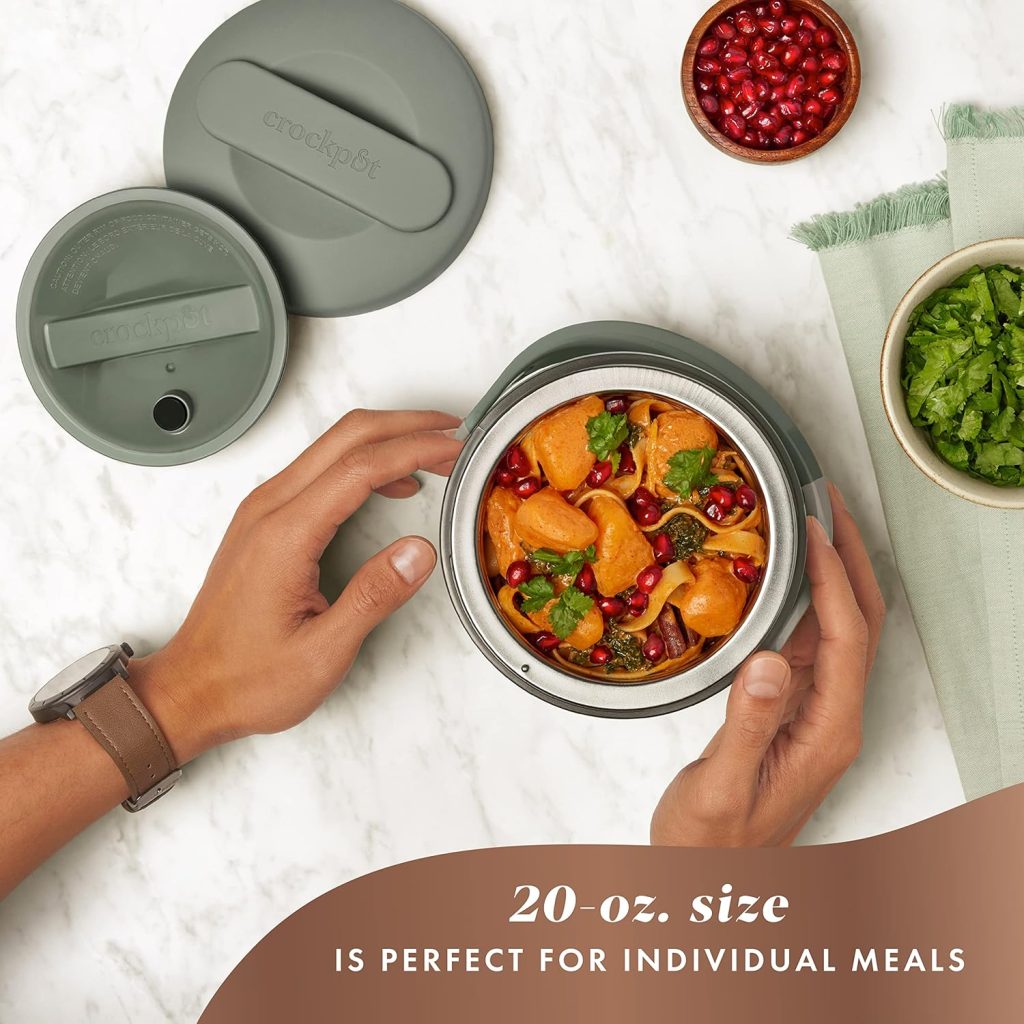
Who it’s for: Office workers, teachers, tradespeople, travelers, and anyone who needs a hot lunch in a location without a microwave — and who has access to a standard wall outlet.
Biggest Pros:
- Genuinely heats food to a satisfying temperature — no dry spots, no cold centers
- Plug it in 1–2 hours before lunch and forget it — no babysitting required
- Gentle slow-heat keeps food from drying out the way a microwave does
- Inner container removes for easy filling the night before and simple cleaning
- Inner bowl and inner lid are dishwasher-safe
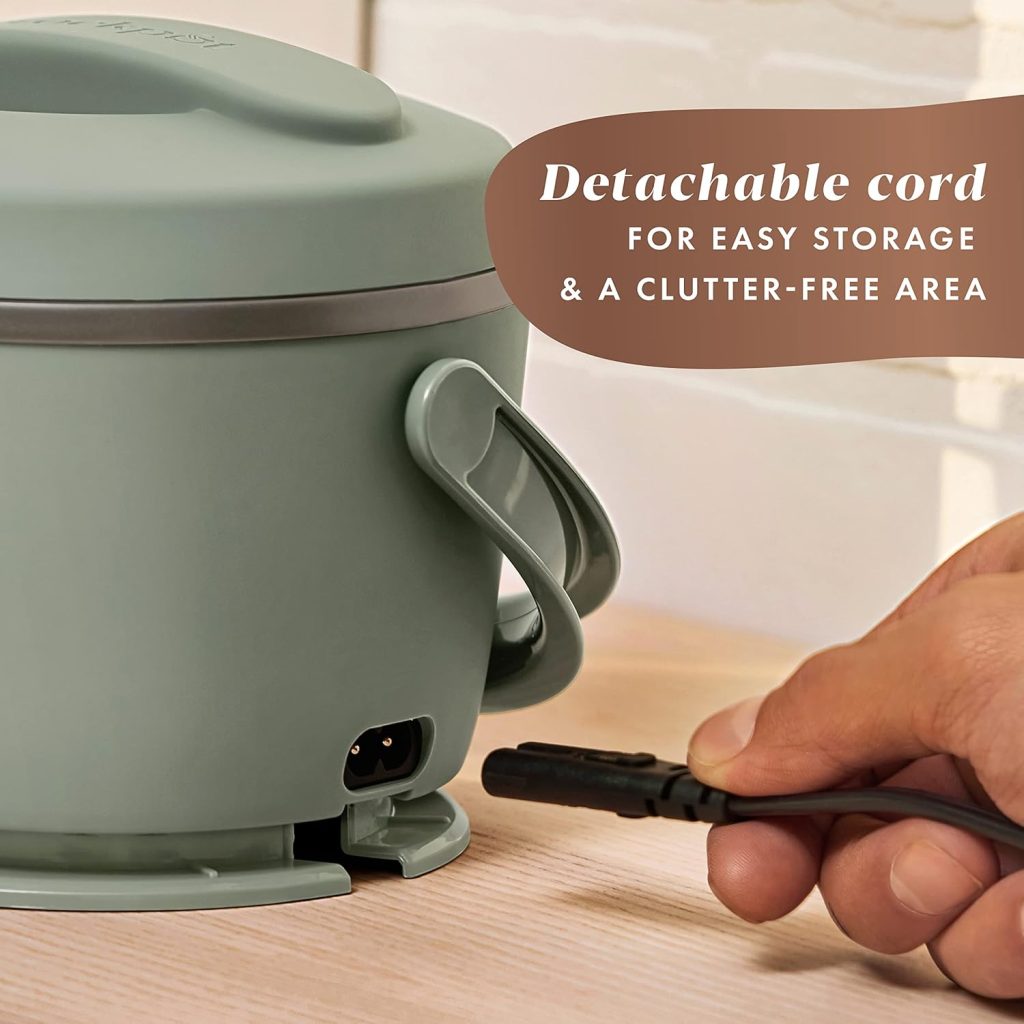
- Detachable cord wraps neatly around the base for clutter-free storage and transport
- Works perfectly for soups, stews, chili, leftovers, oatmeal — virtually anything pre-cooked
- Exterior doesn’t get hot — safe to carry, safe on desks
- Multiple attractive colors; aesthetically a step above the generic lunch container
Biggest Cons:
- This is a food warmer, not a cooker — it cannot cook raw food reliably
- Requires 1–2 hours of warm-up time; not for people with 15-minute lunch breaks who plug in right before eating
- No auto shut-off, no timer, no temperature settings — plug in and unplug, that’s the control system
- The inner lid is the most commonly reported durability weak point — some buyers report it loosening or warping over time
- Requires a standard wall outlet — not a car charger or USB (though a car outlet adapter can solve this)
- 20 oz is the right size for most adults but won’t satisfy a very large appetite
- Only one heat setting
Quick Verdict: One of the best office lunch investments you can make if you plug it in early enough and understand it’s a warmer, not a microwave. The “plug it in when you arrive, eat a hot lunch at noon” workflow is exactly what hundreds of buyers describe — and it works.
Product Overview
The Crockpot Electric Portable Lunch Box is a personal-size, plug-in electric food warmer designed to gently heat pre-cooked meals to a satisfying temperature over the course of 1–2 hours. It is not a miniature slow cooker that cooks food from raw — it uses the same gentle, low-heat principle as a full-size Crockpot, but for the specific job of warming a single serving of food while you work.
Key specs:
- Capacity: 20 oz (approximately 2.5 cups — one satisfying individual serving)
- Wattage: 50 watts
- Dimensions: Approximately 6.54″ H × 6.54″ W × 6.54″ D
- Weight: Under 2 lbs (empty)
- Power: Standard 110V wall outlet (not car, not USB)
- Controls: One setting — plugged in or unplugged
- Inner container material: Stainless steel (matte finish)
- Dishwasher-safe components: Inner food container + inner lid (top rack)
- Exterior: Matte rubberized soft-touch coating; does not get hot during operation
- Cord: Detachable; wraps and stores underneath the base
- Lid system: Dual lid — inner lid (vented, dishwasher-safe) + outer tight-seal lid for transport
- Colors available: Moonshine Green, Blush Pink, Black Licorice, Faded Blue, Sphinx Pink, and others
Key Features Breakdown
The “Plug In and Walk Away” Workflow
This is the core value proposition — and it’s genuinely as simple as it sounds. The workflow that virtually every satisfied buyer describes is: load the inner container with food the night before, refrigerate it overnight, grab it in the morning, plug it into your desk or work outlet when you arrive, and eat a properly hot meal 1–2 hours later.
No microwave line. No waiting. No dried-out corners. No reheating something that was already cooked fine, only to have a microwave make it tough or rubbery. The food quietly comes up to temperature the same way it would in a full-size Crockpot — gently, evenly, with moisture retained.
For workers with early shifts, teachers, tradespeople on job sites without break room access, and anyone who can’t interrupt their day to stand in a lunch line — this workflow is genuinely life-changing in a small way.
Gentle Even Heating vs. Microwave Heating
The reason food heated in the Crockpot Lunch Crock tastes better than microwaved food is physics. Microwaves heat food rapidly and unevenly — causing the edges to overcook while the center stays cold, and often driving moisture out of proteins and rice. The Lunch Crock’s 50-watt gentle heat brings the entire container up slowly and evenly, retaining moisture throughout.
Multiple buyers specifically compare the result: food “tastes fresher,” “more like it just came off the stove,” “not dried out.” One Amazon reviewer who teaches described it as making their food “taste so much better than microwaved leftovers.” That experience is consistent across thousands of reviews and is the most practically meaningful difference this product delivers.
Dual Lid System — Transport vs. Warming
The Lunch Crock has two distinct lids serving different purposes. The outer tight-seal lid snaps securely over the entire top for transport — this is what keeps soup from sloshing around in your bag during the commute. The inner vented lid sits on the food container itself, allowing steam to release during heating while keeping the food environment appropriately moist.
Understanding this dual-lid system matters for two reasons. First: the outer lid is for transport only — you can leave it off during the heating phase. Second: the inner lid is the component buyers report the most wear on over time, which we’ll cover in the cons.
Detachable Cord with Base Storage
The power cord fully detaches from the base, and the base has a slot underneath specifically designed for the cord to wrap and store. This means the unit carries as a self-contained object with the cord neatly tucked away — no dangling wire flapping around in your bag. Multiple buyers note this as a thoughtful design detail that makes a real practical difference for daily carry.
Exterior That Stays Cool
The soft-touch matte rubberized exterior doesn’t heat up during operation. The heating happens inside — between the warming base and the stainless steel inner container. The outside stays safe to touch, safe to carry, and safe to leave on a wooden desk without a mat. This is explicitly confirmed by testing and multiple buyer experiences.
20-Ounce Capacity — Who It’s Right For
Twenty ounces is the equivalent of roughly a bowl of soup or a generous serving of a leftover dinner portion — think one cup of chili with some rice, or a full serving of pasta, or a hearty oatmeal. For most adults eating lunch at work, this is precisely the right amount. For people with larger appetites or who want a full meal plus sides, it may feel slightly small. The size does not accommodate a full family-style serving but is ideal for the individual personal lunch format it’s designed for.
REAL Pros (Based on Customer Reviews)
- “This has been a GAME CHANGER — I plug it in around 10am and by 12, my food is hot and ready to eat” — A substitute teacher at multiple schools who couldn’t count on microwave access; this is the exact use case the product was built for
- “Best money we have spent in a long time” — A husband of a road utility worker who struggled with cold food on the job; the ability to use it anywhere with an outlet transformed his lunches
- “My food tastes so much better than microwaved leftovers — like it just came off the stove” — The flavor and texture advantage over microwave reheating is the most common substantive praise
- “I’ve been the envy of my colleagues and at least 2 others have ordered this” — The “coworker effect” appears repeatedly; people see someone using it, ask about it, and order their own
- “Perfect portion size and I love that I can leave the base in my room and just take the inner bowl home” — The leave-the-base-at-work setup is a consistent buyer behavior that makes daily use even more seamless
- “Works perfectly for soups, stews, oatmeal, leftovers — anything pre-cooked” — The versatility for hot food types is broad as long as food is pre-cooked
- “I love that I don’t have to use a microwave and the container doesn’t leach chemicals into food like plastic would” — The stainless steel inner container earns specific praise from health-conscious buyers
- “Compact and fits right inside my small backpack” — The footprint is small enough to integrate into existing bag setups without requiring a special case
- “The cord wraps around the bottom for easy storage — this is a well-thought-out detail” — Small design choices are noticed and appreciated by regular users
👉 See current price, color options, and reviews on Amazon →
REAL Cons (Based on Customer Reviews)
- It is not a microwave substitute for people with short lunch breaks. This is the most important expectation to set. If you plug this in at 11:45 and expect hot food at noon, you will be disappointed. The warming cycle takes 1–2 hours from refrigerator-cold. The workflow is: plug in when you arrive, eat at lunch. For buyers who understand this upfront, it works perfectly. For buyers who want instant heat, this is not the right product.
- This is a warmer, not a cooker. The Crockpot name creates an expectation that this can slow-cook food the way a full-size model does. It cannot. The brand’s own customer service confirmed: “This unit is not to be used for cooking, it is merely used to warm food.” Raw meat, hard vegetables from raw, and uncooked starches are not appropriate for this appliance. Pre-cooked leftovers and soups are the intended use.
- No auto shut-off, no timer, no settings. Once plugged in, it runs continuously until unplugged. It will not turn itself off. One teacher who used it for 2 hours reported that beyond that point, food started to get soggy. The advice from experienced users: plug in 1.5–2 hours before eating and unplug when the food is hot enough. A smart plug or outlet timer can automate this if needed.
- The inner lid is the weakest durability point. Multiple buyers across platforms report the inner lid losing its snap-fit over time. On Crockpot’s own site, one buyer described calling customer service over a loose inner lid — and the replacement had a redesigned lid that was harder to remove safely because of how tightly it snapped. A separate buyer at Best Buy noted the plastic inner lid can warp from heat over time, no longer sealing as tightly. This isn’t universal, but it’s a consistent enough pattern to flag: the inner lid is the component most likely to wear first.
- Cord fraying is a reported long-term durability issue. One buyer on Crockpot’s own site who used the device 1–2 times per week for a year reported the cord becoming frayed and showing copper wire. This is a safety concern if true — cords should be inspected periodically. Using the cord wrap storage correctly (rather than pinching or bending it sharply) helps extend cord life.
- Requires a standard wall outlet. This is a plug-in appliance. For use in a car, you need a car outlet adapter (the kind that converts a 12V car socket to a standard 110V outlet — these exist and work, but add cost and planning). This is not a USB or 12V native device.
- One TikTok-influenced buyer returned it. One review noted buying it based on the visual appeal and Crockpot aesthetic on social media, then returning it when they realized it only warms food rather than cooking it. This is a legitimate mismatch of expectation vs. product design — worth noting as a signal that the “Crockpot” branding creates expectations the product cannot meet.
Who This Is For (And NOT For)
Perfect for:
- Office workers who arrive 1–2 hours before their lunch break and have a desk outlet
- Teachers (a dominant user group in reviews) who plug in during an early period and eat during lunch
- Tradespeople, electricians, contractors on job sites where the break room is far or nonexistent
- Road workers and travelers who use a car outlet adapter for in-vehicle warming
- Anyone whose office microwave is perpetually crowded, broken, or shared with smelly fish
- People who want to stop eating out at lunch and need a daily reliable system for hot leftovers
- People who are microwave-averse for health or quality reasons
- Anyone looking for a practical, genuinely useful gift for a coworker or professional
Not the right fit for:
- People with 15–30 minute total lunch situations who need instant heat
- Anyone who wants to cook raw food — this warms, it doesn’t cook
- Buyers who need cordless or battery-powered operation for outdoor settings without outlets
- People who want variable temperature control, an auto-shutoff timer, or digital indicators
- Heavy eaters who need more than 20 oz per meal
- Anyone expecting it to operate like a miniature version of a full-size slow cooker — same name, completely different job
Deep Dive: What Customers Are Really Saying
The Crockpot Lunch Crock has one of the most consistent, long-running positive review patterns of any small kitchen appliance in its category — with the caveat that the negative reviews are almost exclusively from buyers who misunderstood what the product was.
The “coworker effect” is real and notable. Across Amazon, Walmart, and the Crockpot brand site, the pattern of “I saw my coworker using this and ordered one immediately” or “now 3 of us at school all have them” appears too frequently to be coincidental. This is a product that converts observers as well as buyers — people see someone eating a hot, fragrant, genuinely appetizing lunch while they’re eating a sad microwave meal, and they want in.
Teachers are the most vocal, most satisfied user group. The scenario is nearly identical across hundreds of reviews: teacher arrives, plugs in the Lunch Crock during their first period, eats a hot meal during their 30-minute lunch break without spending any of that break waiting in line. For teachers who typically have limited break time and often can’t leave their building, this product genuinely improves a daily quality-of-life friction point.
The timing sweet spot is real: 1.5–2 hours, then unplug. This emerges from experienced user reviews as the practical wisdom. Under 1 hour from cold = not hot enough for most foods. Over 2–2.5 hours = food can become soggy or overdone (particularly rice and pasta). One user specifically found 2 hours works for their setup, noting that more than that results in soggy food but less isn’t hot enough. The solution many experienced users adopt is a smart outlet plug — a $10–15 smart plug that lets you set a timer — turning the Lunch Crock into a truly automated hot lunch system.
The inner lid concern is worth taking seriously. This isn’t a universal defect, but it appears consistently enough across platforms — Amazon, Walmart, Crockpot’s own site, Best Buy — to be a real design vulnerability. One buyer on Crockpot’s site described the inner lid becoming loose after first use and later reported the replacement had a redesigned lid that snaps on so tightly that the only way to remove it requires grabbing the hot outer portion. This suggests an ongoing design iteration that hasn’t fully resolved. The practical advice: handle the inner lid gently, don’t force it, and avoid washing it in the dishwasher on high heat settings to extend its lifespan.
Customer Sentiment Breakdown
Overall satisfaction: High — the product holds strong ratings across Amazon, Walmart, and Best Buy, driven by a core user base who uses it correctly and loves it. The negative reviews almost exclusively reflect expectation mismatch (expecting a cooker or instant heat), not product failure.
Most praised: The “plug in and forget it” workflow, genuine food quality compared to microwaved alternatives, the clean portable design, cord storage, leave-the-base-at-work convenience, and the stainless steel inner container.
Most complained about: Warming time requirement (not for short breaks), no auto shut-off, inner lid durability over time, cord fraying with heavy long-term use, and the product not being able to cook raw food.
Review authenticity: The review pattern is highly genuine and specific. Buyers describe their actual professions (teacher, union electrician, utility worker, receptionist), their specific use scenarios, and exact timing (plug in at 10, eat at 12). This is the kind of detail that only comes from real daily use. The negative reviews that are most credible contain specific failure details; the generic negative reviews often simply reflect confusion about what the product does.
Value for Money Analysis
The Crockpot Lunch Crock is priced in the $30–45 range depending on where and when you buy it. Let’s think about this practically.
The inner container is stainless steel — not aluminum-feel cheap plastic — which means no chemical leaching concerns and no flavor absorption over time. The brand is Crockpot, not a generic import. The design has been refined over many product iterations. The soft-touch exterior, detachable cord, dual lid system, and dishwasher-safe components are all thoughtful quality inclusions.
The value case is easy to make: one lunch eaten out costs $12–20 in most cities. This device pays for itself in 2–4 days of use if you were previously buying lunch. For a product that most buyers use daily for months or years, the ROI is essentially immediate.
The only value concern is long-term durability — the inner lid wear pattern and the cord fraying report suggest this is a 2–3 year device with regular daily use, not a decade-long heirloom. For the price, that’s entirely acceptable.
Comparison to Alternatives
vs. Cheaper 12V/110V electric lunch boxes (no-name brands, ~$20–30): These cheaper competitors heat food faster (higher wattage) but heat unevenly — the bottom burns while the sides stay cool. Multiple buyers comparing directly from Crockpot’s own newer model (the GO, which uses a bottom-only heating plate like the cheap competition) explicitly prefer the original Lunch Crock for its all-around heating. Independent reviewers confirmed the Lunch Crock’s surrounding metal design heats the inner container more evenly from all sides, unlike budget alternatives that only heat from the bottom and can burn food at the contact point.
vs. Thermos/insulated food containers (~$25–45): Thermoses maintain temperature but don’t add heat — food only stays as warm as it went in. For piping hot food from the office, a thermos works if you microwave it right before leaving home. For someone who wants to put refrigerator-cold leftovers in and have them hot at lunch, the Lunch Crock is meaningfully better.
vs. Office microwaves: Available everywhere but involves waiting, smell contamination, uneven heating, potential scheduling competition, and the possibility of reheating in plastic containers. The Lunch Crock eliminates all of these at the cost of planning time (plug in early). For daily use, it’s a genuinely better experience.
vs. Eating out: An economic comparison that sells itself. At $35 once vs. $15/day for lunch out, this device pays for itself in just over two lunch breaks.
FAQ Section
Q: How long does the Crockpot Lunch Crock take to heat food? From refrigerator-cold, plan on 1–2 hours for most foods. Soups and liquids heat faster; dense leftovers like casseroles or thick stews take closer to the full 2 hours. The practical routine is: plug in when you arrive at work, eat at your lunch break. This timing works for most standard work schedules. If your break is in 30 minutes, this is not the device to use.
Q: Can you cook raw food in the Crockpot Lunch Crock? No — and this is important. The Crockpot brand has confirmed this: the Lunch Crock is a food warmer, not a cooker. It cannot reliably cook raw meat, raw vegetables, or uncooked grains. Pre-cooked leftovers, soups, stews, chili, oatmeal, and similar already-prepared foods are what it’s designed for.
Q: Does it have an auto shut-off? No. The Lunch Crock runs continuously as long as it’s plugged in. You manually unplug it when done. Many users address this with a $10–15 smart outlet plug that allows you to set an automatic off timer — effectively giving the Lunch Crock a programmable schedule without any modification to the device itself.
Q: Can I use it in my car? The Lunch Crock requires a standard 110V wall outlet. It does not run natively on 12V car power. However, you can use it in a car with a power inverter or a car-mounted outlet adapter that converts 12V to 110V — several buyers specifically mention this setup for road work and commuting. These adapters are widely available for $20–40.
Q: Is the inner container really stainless steel? Yes, though it has a matte, slightly unusual finish that some buyers initially mistake for aluminum. It’s stainless steel — dishwasher-safe, no BPA concerns, no plastic leaching. The matte finish is a manufacturing characteristic, not a sign of lower material quality.
Q: The inner lid got loose — is that normal? Unfortunately, inner lid wear is the most commonly reported durability issue across this product and its predecessors. It’s not universal but it’s consistent enough to be a known pattern. Handling the lid gently, avoiding high-heat dishwasher cycles, and not forcing the snap-fit can extend its life. If the lid fails, contact Crockpot customer service — multiple buyers report successful replacement support.
Q: What foods work best in the Crockpot Lunch Crock? Soups, stews, chili, curries, casseroles, rice dishes, pasta with sauce, oatmeal, and any moisture-rich pre-cooked leftover are ideal. Drier foods (dry rice, grilled chicken without sauce, raw vegetables) can become overly dry or stay unevenly heated. The rule of thumb: if the food has some moisture or sauce, it does well. Dry foods benefit from adding a tablespoon of water or sauce to the container.
Final Verdict: Is the Crockpot Electric Lunch Box Worth It?
Yes — for exactly the right person, it’s one of the best small kitchen purchases you can make.
The Crockpot Electric Portable Lunch Box (20 oz) does one thing: it gently heats pre-cooked food to a satisfying hot temperature over the course of 1–2 hours, with better texture and flavor results than a microwave. It does that job reliably, cleanly, and with a thoughtful design that integrates into a daily work routine with almost no friction.
The people who love it — and they are legion, with the coworker domino effect proving that this product converts observers — are people who plan ahead by one step. The night before: load the container, refrigerate. The morning of: grab and go. At work: plug in. At lunch: eat something genuinely hot and satisfying while everyone else waits for the microwave.
The people who don’t love it are people who expected a microwave or a real slow cooker. That’s a product mismatch, not a product failure.
If you have access to a standard outlet at work, a lunch break that’s 1+ hours after you arrive, and a habit of eating leftovers or soup — this device will slot into your routine so seamlessly you’ll wonder how you ate cold lunches for this long.
If you need instant heat, have no outlet access, or want to cook raw food — look elsewhere.
For everyone else: buy it, load it the night before, plug it in when you get to work, and enjoy the best lunch you’ve had at your desk in years.
👉 Get the Crockpot Lunch Crock on Amazon and choose your color →
Disclosure: This post contains affiliate links. If you purchase through these links, we may earn a small commission at no extra cost to you. All opinions are based on genuine product research and verified customer review analysis.